Showing posts with label NTU. Show all posts

Sunday, October 11, 2009

EMC/EMI lab tour

Last semester, I attended electromagnetic compatibility and interference (EMC/EMI) graduate course in NTU. It is an interesting course which introducing the importance of EMC/EMI test and the way to reduce electromagnetic inteference in circuits and PCB boards. This course was taught by Prof See & Prof Koh. They are indeed knowledgeable and good in teaching, giving clear explanation.

having class in the semi-aechoic chamber

The most impressive part of this course is that we had a lab lecture inside in the Semi-Anechoic Chamber (SAC) at the last lecture. Wow, it is my first time visiting aechoic chamber.

the ceilling of the chamber was covered by absorbers

Antenna test equipments for different frequency ranges

There was a rotating ground plate which can support a tank weight. The metal table was a standard test setup for commercial products like computers and TV.

taking a photo :p

Besides visiting semi-aechoic chamber, we also visited Mode Stirred Chamber (MSC) or reverberation chamber. It was an improved version chamber that could stir electromagnetic wave in all direction to the device under test (DUT). Moreover the build up cost of this chamber is cheaper than SAC type. However MSC chamber is still under heavy research, hence it is not commonly used.

vertical stirrer

horizontal stirrer, near to the ceiling

a remoted plane was placed on a metal test table in the mode-stirred chamber (demo purpose)

Besides this, we also visited a smaller semi-aechoic chamber which filled with different type of absorber.

closure look on the absorber.

photo taking again :p


The alternative test room is to use this shielded enclosure room, which is less costly. But this room is a bit too small, just for demonstration purpose.

Tuesday, September 08, 2009

New bus stop in NTU


Someone put a fake SBS bus-stop (179/199) at a NTU shuttle bus stop. In other word, SBS buses by right will not stop over there but only NTU shutle buses will.

Have fun : )


Sunday, June 14, 2009

Photo taking in School of Art Design Media, NTU

A golf field is built on top of a building roof?

One of the weekend, my friend Xiao Jun and I decided to take a photoshot on School of Art, Design & Media (ADM). I found this building is quite unique and stunning, in term of the building shape, no doubt, becoming an iconic building in NTU. Not sure how to describe the shape of the building. A picture is worth of thousand words, the picture below will give you clear view. The roof is fully covered with grass. It seems like a modern golf field on top of a building if seeing from a far distance. In the center of the school, there is a fountain, enhancing a friendly and cosy environment.

stunning shape of School ADM

entrance to the center of the building
walking along on the roof

my friend, Xiao Jun

having dinner @ canteen 1

walking pathway

Tuesday, June 09, 2009

Prof Raafat Mansour from University of Waterloo

Taking photo with Prof Mansour from University of Waterloo, Canada

In the short semester, I had attended a 10-days microwave filter design short course by Prof Raafat Mansour, a prominent prof from University of Waterloo, Canada. He is a key person in RF/microwave filter and MEMS design. He also an IEEE Fellow and holds numerous of US patents. The book we used was the book written by the prof, called Microwave Filters for Communication Systems: Fundamentals, Design and Applications. From the course, I found the prof is really good and very knowledgeable. I was very glad that NTU has a good system that invites distinguished lecturers for short courses.

---------------------------------------------------------------------------
taking photo with Prof Willy Sansen and circuit team members, while working in Intel.

So far, I have taken photo with 3 IEEE fellows. The first one is Willy Sansen, while I was working in Intel, Penang Malaysia. He is also a key person in the analog design field. The second one is Prof Behzad Razavi, the one I admired the most. I blogged about his workshop few months ago (click here to the post). The third one is Prof. Raafat Mansour. I know him from the short course.


Taking photo with Prof Razavi in a workshop in Singapore

Monday, May 04, 2009

My examination in NTU


Last week my last examination paper was over. What a relief! I think it is difficult to sit for examination again after few years of working. haha.. luckily I was able to adopt and handle it. The picture above was the taken before the examination was started in Lee Kong Chian hall, near to the canteen B in NTU. I did not like to take examination here because the table was small. I had to bend down my spine for 3 hours since I am quite a tall person. It created backache after the exam. I prefer to have a proper table for the exam. Anyway, I think I did well on the examination and I have tried my best :p

Thursday, April 02, 2009

Friday, March 20, 2009

Razavi Workshop/Seminar in Singapore!

Prof Behzad Razavi

Last two week, I received an email from NTU that Institute of Microelectronics (IME), IEEE Singapore MTT/AP Chapter and IEEE Singapore Solid-State Circuits Chapter were going to organiza a two-day workshop by Prof Behzad Razavi, the most distinguish research in the field of analog circuit design + IEEE fellow. The workshop called "High-Performance Analog, RF and mmWave CMOS Design". I was excited receiving the email because I treat him as mentor and I often read his journals and books. I really learn a lot from his research papers and books because his approach in the books is very practical to design rather than complicated formula and calculations. I found his books/papers focus on intuitive ways which allow readers to know the insight of the theories.

content of the workshop

The workshop was divided to few sections. There were ADCs, PLL, Sub 1V RF design on day1, modellig, 1st, 2nd, 3rd generation of 60GHz RF Rx & Tx, and mm-wave circuit technique. Wow, it included a lot of materials in just two day events. It really was an event not to be missed! However it was not a free workshop, the fees for regular participant and IEE member was S$990 and S$790 respectively, it was quite expensive to me. Fortunately, the fee for regular students and IEEE regular students were S$100 and S$75, which were affordable to me. So I quickly joined IEEE membership for USD$12.50. Was it an impulsive move?
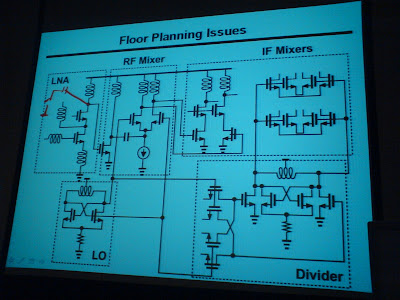
60GHz RF Rx

In this Monday and Tuesday, I attended the workshop in IME building, near to National University of Singapore NUS. The workshop was quite interesting and intensive. Luckily I could follow his pace. I finally saw Prof Razavi in person. Haha.. moreover I eventually took photo with him and my friends as shown in picture below. As overall, I think it is pretty worth for the workshop, because I have gained considerable knowledge (not because of taking photo with him, just part of it), especially in ADC and RF parts. I was impressed with the new black box modelling technique, which was totally out of my knowledge.

The most impressive part I remember, he said to become good RF designers, the designers have to spend at least one year in RF modeling, especially in inductor modelling, then at least another one year in architecture designs and at least another one year in RF circuit designs.

Another thing I would like to highlight is that he, himself, personally did the 60GHz Rx/Tx designs. Only the layout parts were done by his students. Therefore those papers only have his name only (single author name only). Wow, I think no much Profs will spend their times in research works. I really worship him! A truely research and Prof.

Taking photo with Prof Razavi and my friends in the workshop

On the following day, there was a free seminar by Prof Razavi as well in NUS. The topic is about low-power 10-bit pipeline ADC with calibration technique. Of course, I didnt miss it. In the seminar, I was impressed by the new technique which could achieve considerable low power and high accuracy.

Free seminar by Prof Razavi in NUS

closer look: differential op-amp with fast CMFB

Razavi: The performance of INL