Thursday, July 15, 2010


Saturday, June 12, 2010

Friday, June 11, 2010

Wednesday, June 09, 2010
Thesis Collection
Georgia Institute of Technology (Georgia Tech)
http://smartech.gatech.edu/
Texas A&M Univeristy (TAMU)
http://repository.tamu.edu/
The Hong Kong University of Science and Technology (HKUST)
http://repository.ust.hk
Linköping University (LIU)
http://www.ep.liu.se/
University of Twente
http://essay.utwente.nl/
http://smartech.gatech.edu/
Texas A&M Univeristy (TAMU)
http://repository.tamu.edu/
The Hong Kong University of Science and Technology (HKUST)
http://repository.ust.hk
Linköping University (LIU)
http://www.ep.liu.se/
University of Twente
http://essay.utwente.nl/
Wednesday, May 26, 2010

Thursday, May 20, 2010
Cadence: .cdsinit file setup
Here provide some important setup in the .cdsinit cadence file
.cdsinit file
;To enable the bindkey in layout and schematic in Cadence
let( (bindKeyFileList file path saveSkillPath)
bindKeyFileList = '(
"leBindKeys.il"
"schBindKeys.il"
)
;My simulation environment setup
envSetVal("asimenv" "saveDir" 'string "./artist_states")
envSetVal("asimenv.startup" "projectDir" 'string "./simulation")
envSetVal("asimenv.startup" "cds_ade_wftool" 'string "awd")
;To make sure simulator does not save all nodes but selected nodes, otherwise the sim file size is big
envSetVal("spectre.outputs" "save" 'string "selected")
;First row: set the artist_states directory path
;Second row: set project directory path
;Third row: Set AWD as a default waveform viewer
.cdsinit file
;To enable the bindkey in layout and schematic in Cadence
let( (bindKeyFileList file path saveSkillPath)
bindKeyFileList = '(
"leBindKeys.il"
"schBindKeys.il"
)
;My simulation environment setup
envSetVal("asimenv" "saveDir" 'string "./artist_states")
envSetVal("asimenv.startup" "projectDir" 'string "./simulation")
envSetVal("asimenv.startup" "cds_ade_wftool" 'string "awd")
;To make sure simulator does not save all nodes but selected nodes, otherwise the sim file size is big
envSetVal("spectre.outputs" "save" 'string "selected")
;First row: set the artist_states directory path
;Second row: set project directory path
;Third row: Set AWD as a default waveform viewer
Tuesday, May 18, 2010
MATLAB: Plot 2 Y-Axes
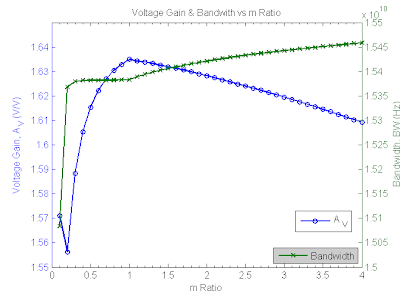
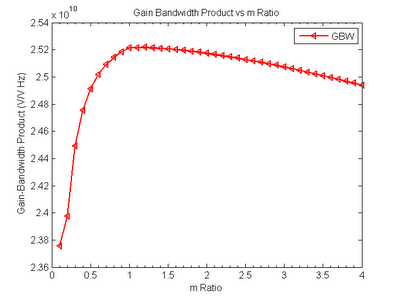
Here is the MATLAB tutorial about plotting a graph with two y axes.
Plotyy function is used to perform the task. Besides this, it also shows how to set/configure the 2 y-axes by using "set" function. In this example, it sets the Y limit range, auto Y tick, line style, marker, line width, title.
To retrieve data from a csv file, use the "load" function. It is easy to use however it is not allowed to have column header. Thus, column headers are required to be deleted manually.
clc %clear working screen
clear %clear all memory
close %close all figure
format short eng
%format short e %format short g
linewidth=1.5; %set line width of a plot
file = 'fixed_Iden_nonlinear1V_5mA_w10u_2.csv';
temp = load(file, '-ascii'); %load a file with data
%[row,col]=size(temp) ; %find row & col size
%retrieve data
ntime = temp(:, 1);
Iden = temp(:, 2);
Av = temp(:, 3);
BW = temp(:, 4);
GBW = temp(:, 5);
Vsw = temp(:, 6);
plotyy(ntime, Av, ntime, BW) %plot with two y axes
[AX,Y1,Y2]=plotyy(ntime, Av, ntime, BW,'plot') ;
%Property_AX=get(AX(1)) %to check property of AX
set(AX(1),'XMinorTick', 'on') %enable minor tick on x-axis
set(AX(1),'YLim',[1.55 1.65]) % Change Y1 axis limit range
set(AX(1),'YTickMode','auto') % Change YTick become auto
set(AX(2),'YTickMode','auto') % Change YTick become auto
set(Y1,'LineStyle','-', 'Marker','o', 'LineWidth', linewidth )
set(Y2,'LineStyle','-', 'Marker','x', 'LineWidth', linewidth )
%set(Y1,'LineStyle','-', 'Marker','o', 'Color','b', 'LineWidth', linewidth ) %set(Y2,'LineStyle','-', 'Marker','x', 'Color','g', 'LineWidth', linewidth )
title('Voltage Gain & Bandwith vs m Ratio');
set(get(AX(1),'Ylabel'),'String','Voltage Gain, A _V (V/V)')
set(get(AX(2),'Ylabel'),'String','Bandwidth, BW (Hz)')
xlabel('m Ratio');
legend( Y1,'A _V', 'Location','Best')
legend( Y2,'Bandwidth', 'Location','SouthEast')
figure
plot(ntime, GBW,'-
%Plot property put after all plots
title('Gain Bandwidth Product vs m Ratio');
set(gca,'XMinorTick', 'on')
ylabel('Gain-Bandwidth Product (V/V Hz)');
xlabel('m Ratio');
legend('GBW')
--------------------------------------------------------------------
Plotyy function is used to perform the task. Besides this, it also shows how to set/configure the 2 y-axes by using "set" function. In this example, it sets the Y limit range, auto Y tick, line style, marker, line width, title.


clc %clear working screen
clear %clear all memory
close %close all figure
format short eng
%format short e %format short g
linewidth=1.5; %set line width of a plot
file = 'fixed_Iden_nonlinear1V_5mA_w10u_2.csv';
temp = load(file, '-ascii'); %load a file with data
%[row,col]=size(temp) ; %find row & col size
%retrieve data
ntime = temp(:, 1);
Iden = temp(:, 2);
Av = temp(:, 3);
BW = temp(:, 4);
GBW = temp(:, 5);
Vsw = temp(:, 6);
plotyy(ntime, Av, ntime, BW) %plot with two y axes
[AX,Y1,Y2]=plotyy(ntime, Av, ntime, BW,'plot') ;
%Property_AX=get(AX(1)) %to check property of AX
set(AX(1),'XMinorTick', 'on') %enable minor tick on x-axis
set(AX(1),'YLim',[1.55 1.65]) % Change Y1 axis limit range
set(AX(1),'YTickMode','auto') % Change YTick become auto
set(AX(2),'YTickMode','auto') % Change YTick become auto
set(Y1,'LineStyle','-', 'Marker','o', 'LineWidth', linewidth )
set(Y2,'LineStyle','-', 'Marker','x', 'LineWidth', linewidth )
%set(Y1,'LineStyle','-', 'Marker','o', 'Color','b', 'LineWidth', linewidth ) %set(Y2,'LineStyle','-', 'Marker','x', 'Color','g', 'LineWidth', linewidth )
title('Voltage Gain & Bandwith vs m Ratio');
set(get(AX(1),'Ylabel'),'String','Voltage Gain, A _V (V/V)')
set(get(AX(2),'Ylabel'),'String','Bandwidth, BW (Hz)')
xlabel('m Ratio');
legend( Y1,'A _V', 'Location','Best')
legend( Y2,'Bandwidth', 'Location','SouthEast')
figure
plot(ntime, GBW,'-
%Plot property put after all plots
title('Gain Bandwidth Product vs m Ratio');
set(gca,'XMinorTick', 'on')
ylabel('Gain-Bandwidth Product (V/V Hz)');
xlabel('m Ratio');
legend('GBW')
--------------------------------------------------------------------
Saturday, May 15, 2010
No Such Thing as ‘Straight’
(source from http://www.harveker.com/)
The textbook definition of “straight” is something that has no bends, angles or curves. Can we apply that same definition to life? Heck no!
There really isn’t such thing as “straight” in the universe. At the core of everything—including us—is energy, and energy doesn’t travel straight. It travels in waves. Imagine throwing a pebble into a lake, watching the ripples gliding across the surface.
Right after you throw your pebble, someone else also tosses a pebble in the same lake, and now the ripples from that pebble collide with the ripples from yours. That’s how everything in this universe works.
People, events, actions and reactions are constantly colliding, creating new pathways, new situations, new circumstances and new actions. The chaos of life makes it almost impossible for anyone to always go “straight” to where they planned.
Some people thrive on chaos and change, but most people don’t. They get frustrated, down, and ready to throw in the towel because they usually have expectations, and these expectations are usually damn near impossible to meet.
We might as well just accept it: the road to success comes with twists, turns, ups, downs, stops and reverses. Once we really understand and accept this, we’re less likely to be deluded into having unrealistic expectations that there’s a straight line to the top. So when we come across bumps, flat tires, and raised bridges along the way, we won’t be so quick to get upset or give up. Getting off track is normal and therefore “perfect.”
You have to expect to spend a great deal of time making mistakes—or if it sounds better—“correcting yourself.” There’s a reason why perfectionists have a hard time being highly successful. Perfectionism is a form of fear, based on fear of failure or the fear of disapproval.
If perfectionists don’t get it exactly right, then they don’t have to finish, follow through, and move on. They get to stay stuck “until its right,” but of course it’ll never be right, so they never have to face the possibility of rejection or disappointment.
We need to consider mistakes—rather than something to be avoided at all costs—instead as “feedback.” Mistakes are our perfectly natural learning curve. They are the feedback we need to get ourselves back on track.
Then we can do the same thing we already know we need to do in order to keep moving forward: take action! Those actions will produce results, sometimes more mistakes. Then we just get that feedback, use it to correct our course again, and then take more action.
This is the non-linear cycle toward success. As long as you use this cycle—and persevere—it’s virtually impossible to fail.
Remember, we’re all ripples in the lake of the universe. You never know how a comment, observation, or minor detail can change the course of your life or another’s!
Now It’s Your Turn!
Subscribe to:
Posts (Atom)